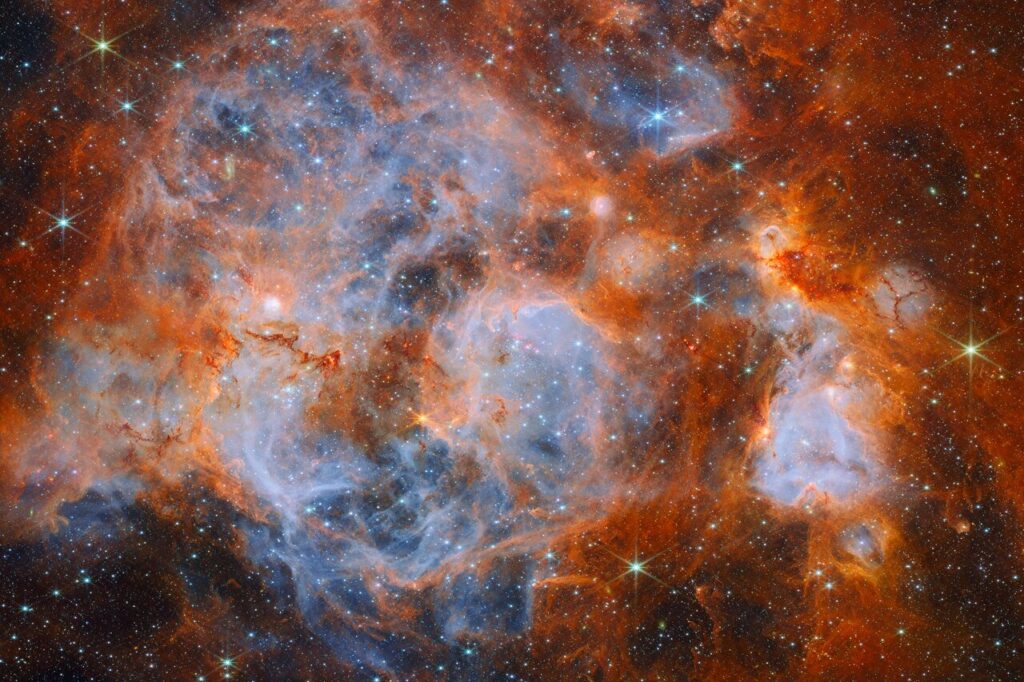
In this Picture of the Month from the NASA/ESA James Webb Space Telescope, we visit a turbulent cauldron of star formation to see what is brewing inside dense clumps of gas. This is a star-forming region named LHA 120-N 159, or simply N159, located 161 000 light-years away in the Large Magellanic Cloud (LMC), one of the satellite galaxies orbiting the Milky Way galaxy. This image spans about 230 light years across. N159 is what astronomers call a H II region: an area of space filled with ionised hydrogen gas. In stellar nurseries such as this one, giant molecular clouds of cold hydrogen gas collapse under gravity, forming new stars. Many of these stars are extremely massive and hot, and their powerful ultraviolet radiation ionises the gas around them. This makes H II regions markers of active star formation, and as the ionised gas radiates light this turns them into the kind of brilliant emission nebula that we see in this image. The fierce stellar winds from these stars sculpt dense ridges and carve open cavities in the gas, which Webb’s Near-Infrared Camera (NIRCam) captures here in great detail. The roiling brew of star formation in N159 is closed in by thick, smoky orange clouds that also billow across the centre of the image. The light orange colour signifies light emitted by polycyclic aromatic hydrocarbons, an important carbon-based molecule. The pools of pale blue gas are clouds of H II gas, ionised by the intense ultraviolet light from massive stars. Dark red filaments cross the centre of the image, particularly visible above the blue region on the right side; these are made of cool molecular hydrogen. These filaments are the densest part of the nebula and currently shield new stars from harsh radiation and stellar winds — by zooming in, you can see stars as points of light embedded in these filaments and in the small pillars of orange gas that reach out into the blue bubbles. Eventually, these structures will melt away, leaving their completed
Una extraordinaria imagen del James Webb Space Telescope permite observar cómo nacen nuevas estrellas en una región situada a unos 161.000 años luz de la Tierra.
Se trata de N159, una gigantesca nube de gas y polvo ubicada en la Gran Nube de Magallanes, una galaxia vecina de la Vía Láctea.
La imagen muestra una región de aproximadamente 230 años luz de extensión, donde densas concentraciones de hidrógeno se contraen por efecto de la gravedad.
En su interior nacen estrellas jóvenes, algunas especialmente grandes y calientes, cuya radiación transforma el gas que las rodea.
Los tonos azules, anaranjados y rojizos permiten distinguir distintas estructuras y componentes de esta región cósmica.
Las observaciones ayudan a los astrónomos a comprender mejor los procesos de formación estelar.
La imagen original fue publicada por ESA/Webb el 22 de octubre y recibió nueva cobertura científica el 27. Se trata, por tanto, de una continuación informativa, no de una observación realizada ayer.